Navigating the Odds: The Role of Skill vs Luck in Casino Games
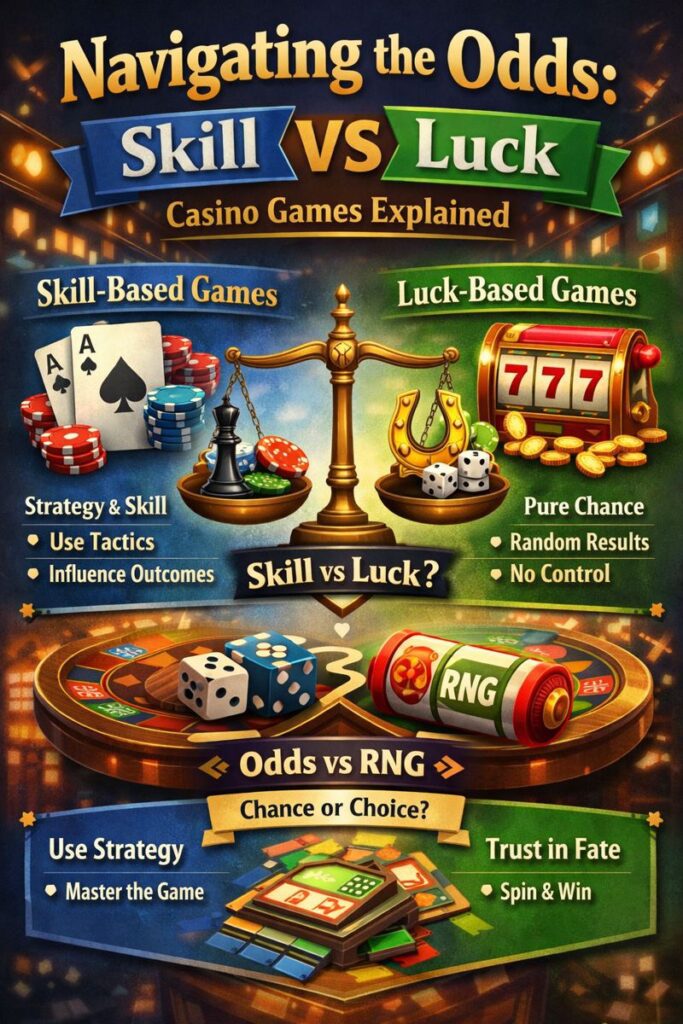
Skill and luck play distinct roles in the world of casino gaming, influencing both your experience and potential outcomes. Skill refers to a player’s ability to influence a game’s outcome through decisions and strategies. Luck, on the other hand, represents outcomes determined entirely by random chance, completely outside player control. Understanding the balance between skill vs luck in casino games can transform how you approach gambling and manage your expectations.
Whether you’re a seasoned player or new to casinos, knowing which games reward skill and which rely purely on luck helps you make informed choices about where to focus your time and money. This post explores both skill-based and luck-based casino games, examining the fundamental differences between them and how they affect your chances of winning.
Understanding Skill vs Luck
At their core, skill-based and luck-based games operate on entirely different principles. This distinction shapes everything from how you play to your long-term results.
In games based on skill, players can significantly influence outcomes through strategy, knowledge, and experience. These games reward study and practice – the more you learn and apply effective strategies, the better your results tend to be over time. While luck still plays a role in individual sessions, skilled players demonstrate measurable improvement with experience.
Luck-based games, conversely, operate on pure chance. No strategy, knowledge, or skill can change the fundamental odds or give you an advantage. Each spin, roll, or deal is an independent event with fixed probabilities that remain unchanged regardless of what happened before.
The odds vs RNG explained dynamic further illuminates this difference. Skilled players understand probability and odds, using this knowledge to make optimal decisions. In luck-based games, random number generators (RNGs) ensure completely unpredictable outcomes that no strategy can overcome.
This fundamental difference becomes clearer when observing player results over time. In skill-based games, experienced players show consistent performance patterns that stand out from random chance. Professional poker players, for instance, maintain profitability over thousands of hands because their skill overcomes short-term variance.
Games Based on Skill in Casinos
Several casino games reward player knowledge and strategic decision-making. Let’s examine the most popular games based on skill in casinos and how they allow players to influence outcomes.
Poker
Poker stands as the quintessential skill-based casino game. While luck determines which cards you receive, skill governs how you play them. Expert players consistently outperform beginners through:
- Strategic betting decisions
- Ability to read opponents
- Bankroll management
- Mathematical understanding of odds
- Psychological manipulation
For recreational players, poker is approximately 30% skill and 70% luck. For professionals, these figures typically reverse. The game’s skill component becomes increasingly evident over larger sample sizes, where superior decision-making consistently overcomes the randomness of individual hands.
More about this dynamic can be found in the analysis on skill and luck in gambling.
Luck-Based Casino Games
Pure luck-based games feature entirely random outcomes with no meaningful strategy component. These games operate on fixed odds that remain unchanged regardless of player actions or past results.
Slots
Slot machines represent the purest form of luck-based gaming. Modern slots operate on random number generators (RNGs) that determine outcomes. Key characteristics include:
- Each spin is an independent event with no connection to past or future spins
- No strategy can influence the programmed return-to-player percentage
- Outcomes are determined the moment you press the button
- No pattern recognition or timing technique can improve odds
Slots account for the majority of casino floor space and revenue precisely because their outcomes remain purely random, ensuring consistent house edges regardless of player behavior.
Odds vs RNG Explained
Understanding the relationship between odds and random number generators (RNGs) helps clarify how both skill and luck-based games function at a fundamental level.
How RNGs Work
Random Number Generators form the backbone of modern electronic casino games. These sophisticated algorithms produce completely random outcomes through complex mathematical processes:
- They generate thousands of numbers per second
- Each number corresponds to a specific game outcome
- They operate continuously, even when the game isn’t being played
- The outcome is determined at the exact moment you initiate play
In luck-based games, RNGs guarantee that outcomes remain entirely unpredictable and independent of all previous results. This technological foundation ensures fairness while maintaining the casino’s mathematical advantage.
Understanding the distinction between skill and luck in casino games transforms how you approach gambling. Games like poker, blackjack, and sports betting reward knowledge, experience, and strategic decision-making, allowing skilled players to improve their results over time. Games like slots, roulette, and keno depend entirely on random chance, where no strategy or skill influences outcomes.
The balance between skill and luck varies across the spectrum of casino games. Even in highly skill-based games like poker, luck still plays a significant role in determining short-term results. The advantage of skill emerges primarily over large sample sizes, not individual sessions.
We invite you to share your experiences with skill vs luck casino games in the comments below. Have you found more enjoyment in skill-based or luck-based games? Have strategic approaches improved your results over time? Your insights might help other readers navigate their own casino journeys.